An attractive and bright straw-yellow color. Subtle and elegant with a touch of minerality imparted by the limestone soils, combined with aromas of white flowers and fruit, accompanied by very subtle hints of bakery after its brief aging in 500L new French oak barrels. Its freshness on the palate is remarkable, and it also possesses great body and volume, complemented by its balanced acidity.
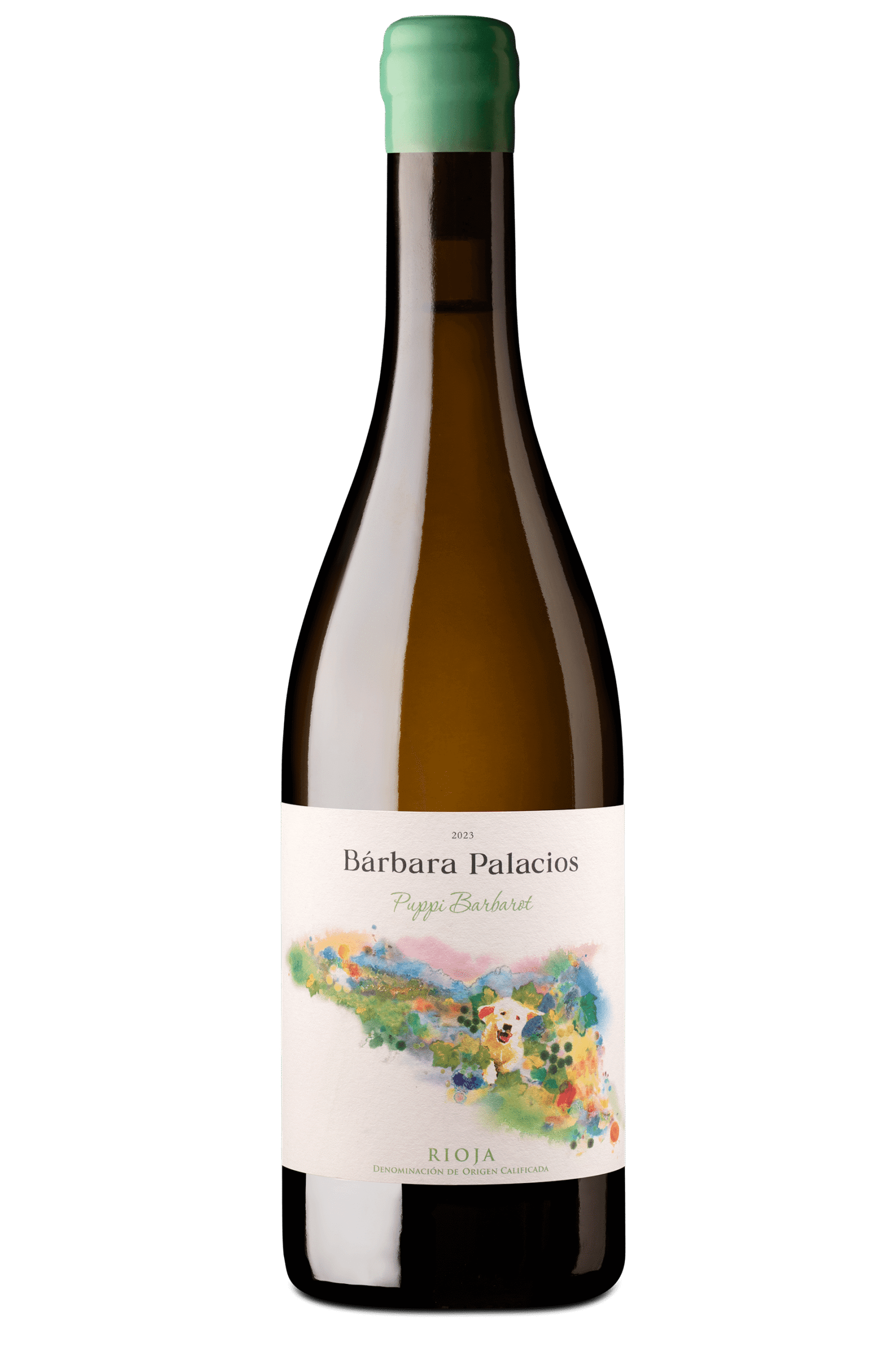
Bárbara Palacios
2023 puppi barbarot BLANCO
From the very beginning, Merlot, my dog, has been a tireless companion. In the most innocent way, he became part of the image and name of Barbarot (Barbara and Merlot). Once again, we want to include him in the image, this time as a puppy. In Puppi, we aim to integrate the grapes from the young vineyards we have planted and thus learn to unlock their full potential. Puppi Barbarot represents the birth of new hopes resulting from the expansion of our vineyard, overflowing with youth and the joy of a puppy.
Tasting note
2023 VINTAGE
The end of 2022 saw fairly moderate temperatures, making November a transitional month to winter, following an exceptionally dry year. November was a damp month with not overly cold temperatures. Winter, however, brought colder temperatures, reaching 0°C or even light frosts on some nights. Rainfall was intermittent, but the first snowfalls of the season did occur in the Haro area. With the arrival of March, temperatures also softened, marking the transition to spring. It was one of the warmest and driest springs recorded since 1995. However, the crop was seriously compromised during the last week of August, with consecutive days of temperatures reaching 40°C, which affected the leaves and fruit, halting ripening. Although the summer was reported to be rainier than previous years in the area where the vineyard is planted, the rainfall was not particularly abundant. These conditions strengthened the health of the vines and yielded high-quality grapes, although there were challenges in terms of acidity and overall fruit balance.
2023 HARVEST
The Viura grapes were harvested on August 21st and the Garnacha Blanca on September 23rd, aiming to harvest before full ripeness. The grapes were hand-picked into small crates, with bunch selection. They were destemmed, and the must was cold-soaked with the skins for 48 hours. The grapes were then pressed in a vertical stainless steel press, aided by firm foot treading. After 24 hours, the must was floated to settle and then fermented at 16°C. Once fermentation was complete, it was aged in an egg-shaped tank, which promotes the natural stirring of the fine lees and ensures micro-oxygenation similar to barrel aging, preserving the fruit and aromas. As a test, 300 liters of Viura from Alfaro, "Temeraria," were added. Although initially the aromas weren't prominent, after several months in the egg-shaped tank, the Viura's character emerged, imparting a terpene note.
The wine also spent two months in French oak barrels, where very subtle woody aromas developed. Finally, it was racked and left to rest on its fine lees for three months, then clarified and bottled.
The wine also spent two months in French oak barrels, where very subtle woody aromas developed. Finally, it was racked and left to rest on its fine lees for three months, then clarified and bottled.